NVMe interrupt coalescing
Sales pitch: database too slow on a new NVMe box? Check whether the drive left interrupt coalescing on. Turning it off is free and, on the DGX Spark lab host, made the OSM Relations phase about 1.75× as fast.
What it is
NVMe can delay completion interrupts until N completions pile up on a queue, or a timer fires. Desktop OEM firmware — and some vendor boot scripts — sometimes leave something like 100 µs aggregation, threshold 8 (0x107). That helps interrupt rate and sequential throughput. It is a bad match for Postgres buffer misses: a backend waiting on one synchronous pread never reaches 8 completions, so every read can wait out the timer.
Interrupt coalescing only changes when the drive signals completion (batch N completions or wait ~100 µs). It does not add, remove, or resize write commands, and it does not change how the controller programs NAND. Host write volume and write amplification stay the same; you just get more interrupts (and a bit more CPU) when it is off. That is a claim about this feature alone. Other nvme set-feature knobs, power-state / APST play, write-cache flips, forced TRIM storms, or synthetic fio write torture can absolutely wreck endurance — and people often change several things in one sitting. If wear skyrockets after a tuning binge, do not pin it on clearing feature 8; isolate changes, and treat everything beyond this interrupt-timing switch as your own experiment.
Check and clear (not saved to the drive unless you pass a save flag):
nvme get-feature /dev/nvme0 -f 8 -H
nvme set-feature /dev/nvme0 -f 8 -V 0
pgbent does the clear in pgbent_tune when nvme-cli is installed. A power cycle restores the firmware default until the script runs again. On DGX OS the story is stronger: the nvidia-nvme-options package installs nvidia-nvme-interrupt-coalescing.service, which turns coalescing on at every boot for Samsung, Kioxia, and Micron drives. Clearing feature 8 once is not enough if that unit is still enabled — stop/disable (or mask) the service, then set -V 0. NVIDIA documents the service and the enable/disable helpers in the DGX OS 8 additional-software guide (package notes in the software stack appendix). The Grace performance tuning guide shows the same 0x107 recipe as the intended “coalesce to cut interrupt overhead” setting — the QD1 latency cost is the other side of that trade.
Spark / token generation (outbound pitch)
Nobody can promise this will help your token-generation path — those stacks vary a lot, and many never miss to SSD while decoding. What was unclear is now easy to try: DGX OS quietly turns on NVMe interrupt coalescing at boot (nvidia-nvme-interrupt-coalescing.service → feature 8 = 0x107), and at queue depth 1 that can more than double random-read speed. Mask the unit, nvme set-feature … -f 8 -V 0, and A/B on your own stack. As far as a guess goes for tokens: you might see some tail latency reduction when generation waits on a lonely SSD read — not a claim about average tokens/sec. Model load and high-QD sequential I/O usually will not move.
The evanwtf/local-llm project already measured the storage side on Spark (same drive family MZALC4T0HBL1 / NXHB202Q): fio QD1 4 K random roughly ~200 µs → ~55 µs median with coalescing off; QD32 and large sequential barely changed. They masked the service so upgrades could not flip it back. No link here (third-party hosting tripped a Safe Browsing warning); credit to that project for the fio A/B and the mask-the-unit note.
Evidence (court / DGX Spark)
Host notes (power sensors, NIC EEE / ASPM): NVIDIA DGX Spark.
Samsung MZALC4T0HBL1, firmware NXHB202Q, with coalescing active (DGX OS boot service / shipped default). Twilight’s Kingston had it off. Same Postgres durable face, same select-scatter-64 / OSM shape:
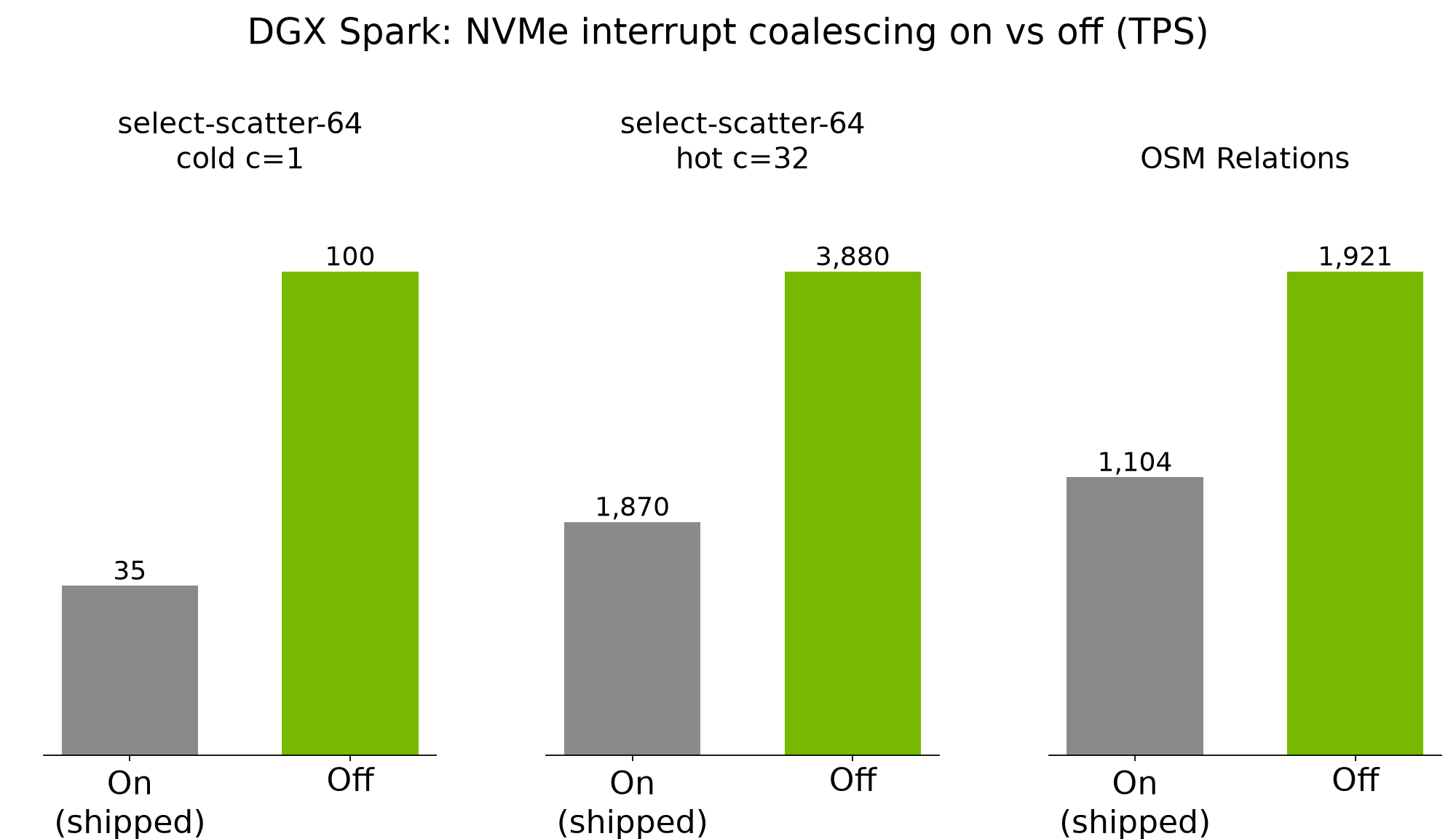
| Coalescing on (shipped) | Coalescing off | |
|---|---|---|
| select-scatter-64 cold c=1 | ~35 TPS | ~100 TPS |
| select-scatter-64 hot c=32 | ~1870 TPS | ~3880 TPS |
| OSM Relations | 13251 s (~1104/s) | 7614 s (~1921/s) |
Relations ~1.75× faster (overall wall clock also improved; not charted here). Court still trails a similar-class x86 host by about 2× on Relations — not parity, and not claimed to be. Isolation ruled out AIO method, effective_io_concurrency, and IRQ pinning as the main lever.
Regenerate: MPLBACKEND=Agg MPLCONFIGDIR="$PWD/.matplotlib-cache" .venv-graph/bin/python reports/nvme-coalescing-compare.py
Full write-up: ARM random read vs x86.