osm2pgsql Workload
The osm2pgsql loading program populates the entire Open Street Map planet data set. Based on the options you can get a svelte version suitable for production, or one with fully decoded metadata build options at about 750GB. Until about 2020 there were multiple heavy CPU bound problems running this loader. Major improvements in the Open Street Map distribution, loading workflow, and the underlying PostgreSQL on Linux platform turned the loading into a capable SSD challenger. Particularly useful were its chain of CTAS single core work speeding up and CREATE INDEX becoming multi-process.
The main downside of this test is that you can’t reach the high speeds unless you have a client available capable of caching the entire nodes data file, which is growing steadily toward where the popular 96GB threshold can barely host it. That size has only recently become feasible on Apple Silicon Mac hardware, and that’s limited the practicality this workload to measure OS X fairly so far. Correspondingly that’s made it hard for this one workload to be a fully general PostgreSQL testing platform.
This load does not benefit very much from larger core or socket counts. Relation building is the hard CPU phase and it does not fill a second CCD or a second socket; extra cores mostly add package watts. The 9600X→9950X swap barely moved OSM score. Where ARM still trails, it has been desktop platform I/O path issues rather than the chips themselves — see ARM random read vs x86.
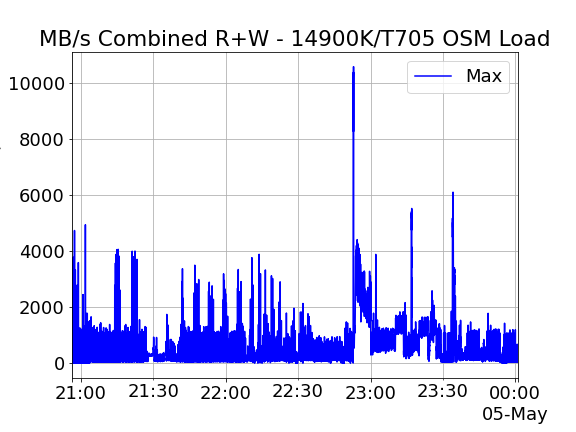
pgbench grids ran out of work that could saturate modern SSD (PG13 random-read check); the planet load is the write/checkpoint gear change. The series is on Greg Smith’s Crunchy author page. Recent OSM results: Loading the World, talk, social. That runs via pgbent’s arbitrary workload interface. Classic shell scripting; no pgbench.