Leaderboards
Public OSM planet-load and pgbench SELECT rankings from the pgbent farm personally run by Greg Smith. This page is updated when there are new cells; it is not a live dashboard.
The OSM table is the current Planet extract (10.79 billion nodes), mixed PostgreSQL 16–19, ranked by OSM score. The PostgreSQL 18 snapshot remains the last frozen release cycle. Watts, durability (fsync / wal_level), and checkpoint columns travel with the OSM rows.
OSM
Best OpenStreetMap planet load per machine × version × durability cell (host-local client). Only extracts with at least 10 billion nodes are eligible. Each row is the score_kips winner for that CPU/memory/disk, PostgreSQL major, fsync, wal_level, and max_wal_gb, with average and peak disk MB/s and package watts from the same run — the grid the power-efficiency study will use. Ranked by OSM score (score_kips): node count divided by relation + polygon + line time, in kNodes/s. overall_kips is the full load; index_kips is index build. Fast cells (fsync=off / wal_level=minimal) stay on the board and are labeled, not hidden. Per-watt columns use peak package power; pwr_est means only the peak was sampled.
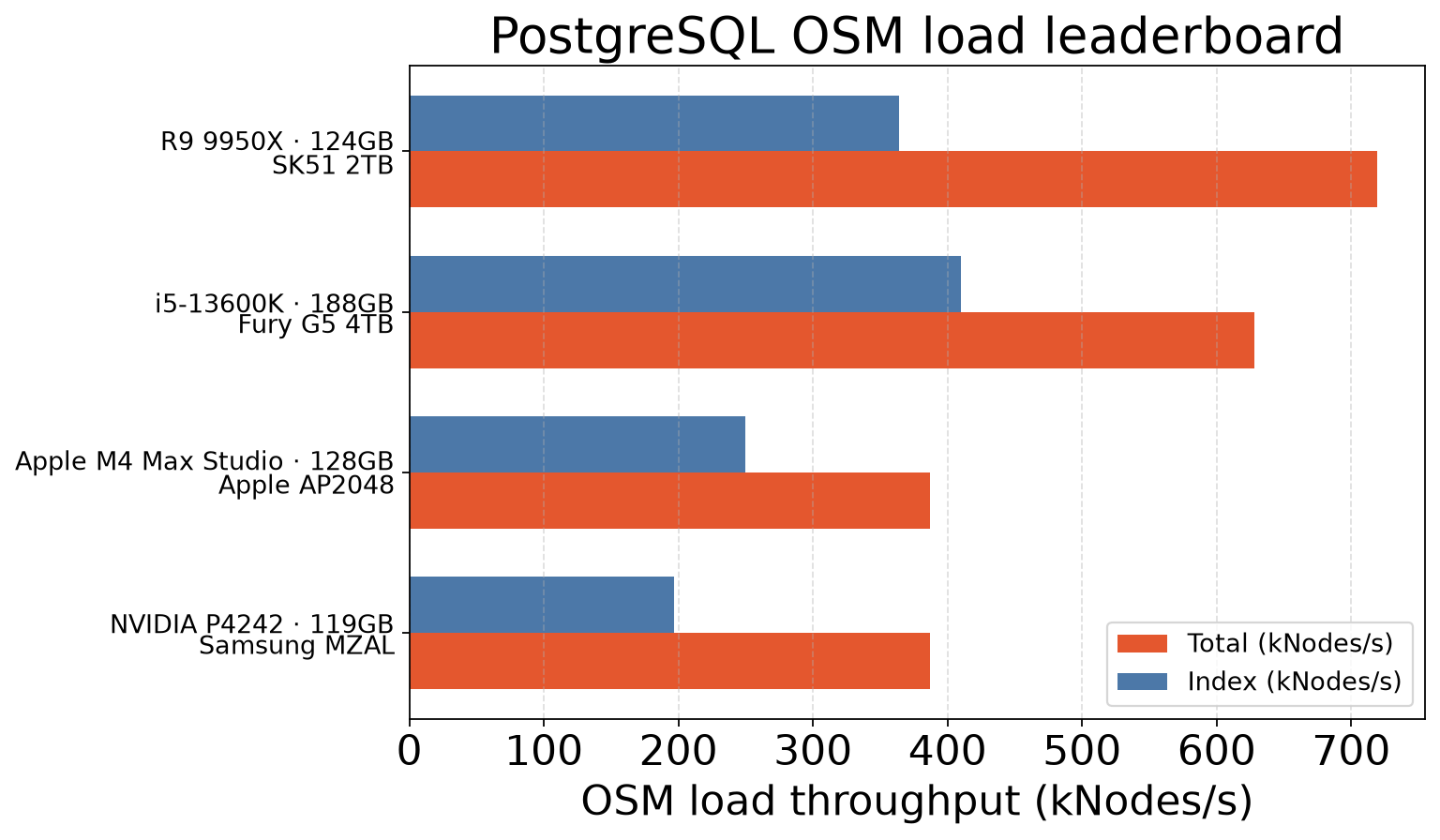
The chart still keeps one bar pair per machine (best score on that box). R9 9950X leads at 1480 OSM score (719 overall kNodes/s, PostgreSQL 19, fsync=off, 70 W average / 180 W peak). i5-13600K follows on the same Planet.
Query returned 11 rows.
| cpu | mem_gb | disk | ver | fsync | wal_level | max_wal_gb | conn | hours | score_kips | overall_kips | index_kips | rel_ps | avg_write | max_write | avg_read | max_read | pwr_est | avg_pkg | max_pkg | score_per_watt | overall_per_watt | index_per_watt | wal |
|---|---|---|---|---|---|---|---|---|---|---|---|---|---|---|---|---|---|---|---|---|---|---|---|
| R9 9950X | 124 | SK51 2TB | 19 | off | minimal | 100 | host | 4.17 | 1480 | 719 | 364 | 4529 | 79 | 7772 | 68 | 9748 | 70 | 180 | 8.2 | 4 | 2 | 20.4 | |
| i5-13600K | 188 | Fury G5 4TB | 19 | off | minimal | 100 | host | 4.78 | 1407 | 628 | 410 | 4590 | 51 | 9692 | 42 | 9342 | 48 | 146 | 9.6 | 4.3 | 2.8 | 17.8 | |
| i5-13600K | 188 | Fury G5 4TB | 18 | off | minimal | 256 | host | 4.8 | 1310 | 625 | 319 | 4364 | 52 | 9742 | 43 | 7627 | 50 | 151 | 8.7 | 4.1 | 2.1 | 17.6 | |
| R9 9950X | 124 | SK51 2TB | 19 | on | replica | 100 | host | 4.34 | 1203 | 690 | 282 | 4516 | 106 | 6099 | 67 | 9666 | 70 | 183 | 6.6 | 3.8 | 1.5 | 97.1 | |
| R9 9950X | 124 | SK51 2TB | 18 | on | replica | 100 | host | 4.45 | 1149 | 673 | 269 | 4425 | 108 | 5108 | 66 | 9429 | 70 | 181 | 6.4 | 3.7 | 1.5 | 102 | |
| i5-13600K | 188 | Fury G5 4TB | 19 | on | replica | 100 | host | 5.03 | 1099 | 596 | 313 | 4468 | 67 | 9151 | 40 | 9110 | 48 | 150 | 7.3 | 4 | 2.1 | 83.4 | |
| R9 9950X | 124 | SK51 2TB | 18 | on | replica | 256 | host | 4.54 | 1088 | 661 | 300 | 4398 | 103 | 6283 | 67 | 9457 | 70 | 174 | 6.2 | 3.8 | 1.7 | 93.2 | |
| Apple M4 Max Studio | 128 | Apple AP2048 | 17 | off | minimal | 256 | host | 7.75 | 578 | 387 | 250 | 1358 | 331 | 4159 | 331 | 4159 | 8 | 37 | 15.5 | 10.4 | 6.7 | 10.7 | |
| Apple M4 Max Studio | 128 | Apple AP2048 | 18 | off | minimal | 100 | host | 7.49 | 561 | 400 | 171 | 1674 | 325 | 6125 | 325 | 6125 | 9 | 35 | 16.1 | 11.5 | 4.9 | 11.3 | |
| NVIDIA P4242 | 119 | Samsung MZAL | 16 | off | minimal | 256 | host | 7.75 | 504 | 387 | 197 | 1156 | 130 | 6115 | 111 | 6216 | 24 | 63 | 8 | 6.1 | 3.1 | 10.7 | |
| Apple M4 Max Studio | 128 | Apple AP2048 | 18 | on | replica | 100 | host | 11.1 | 265 | 270 | 69 | 1396 | 285 | 4578 | 285 | 4578 | 7 | 25 | 10.8 | 11 | 2.8 | 41.6 |
Regenerate: MPLBACKEND=Agg MPLCONFIGDIR="$PWD/.matplotlib-cache" .venv-graph/bin/python reports/osm-leaderboard.py --from-db (runs reports/osm-leaderboard.sql). Previous cycle used a smaller Planet (~9.3B nodes): OSM Leaderboard (PG18 snapshot). Workload notes: OSM.
pgbench SELECT
Phoronix-comparable SELECT cells: -M prepared, 90s, scale 100, single-client and full-client. Package power and memory sit on the same row as TPS on the sockets face (one machine, complete accounting). Combining client and server watts across boxes is out of scope. Postgres developers care whether a code change moves power and memory up or down. For hardware outside this lab, use OpenBenchmarking.org pts/pgbench as the comparable TPS set.
The board has two faces: on-box unix sockets, and a network client. OpenBenchmarking’s multi-million TPS numbers are the networked face on DC hardware, not unix sockets sharing the server with pgbench. A sockets-versus-network mapping study will be published once. The remote rate sweep (same Mbps labels as OSM Network) sits with that study, not as a third ranking.
Current published SELECT grid (older mix of protocols): pgbench SELECT (PG18 snapshot). Workload notes: pgbench grids.
Sockets
Unix-domain connections (SOCKETS=1), prepared statements. Clients run on the server. This is the power-ranking cell.
Networked
TCP to a dedicated client (host), prepared statements. Unthrottled only on this board. This is the face that can exceed on-box rates once the link is faster than ~10Gb/s.
Contact
Greg is on Discord or e-mail. This page is the lab ranking, not an open submission program.